


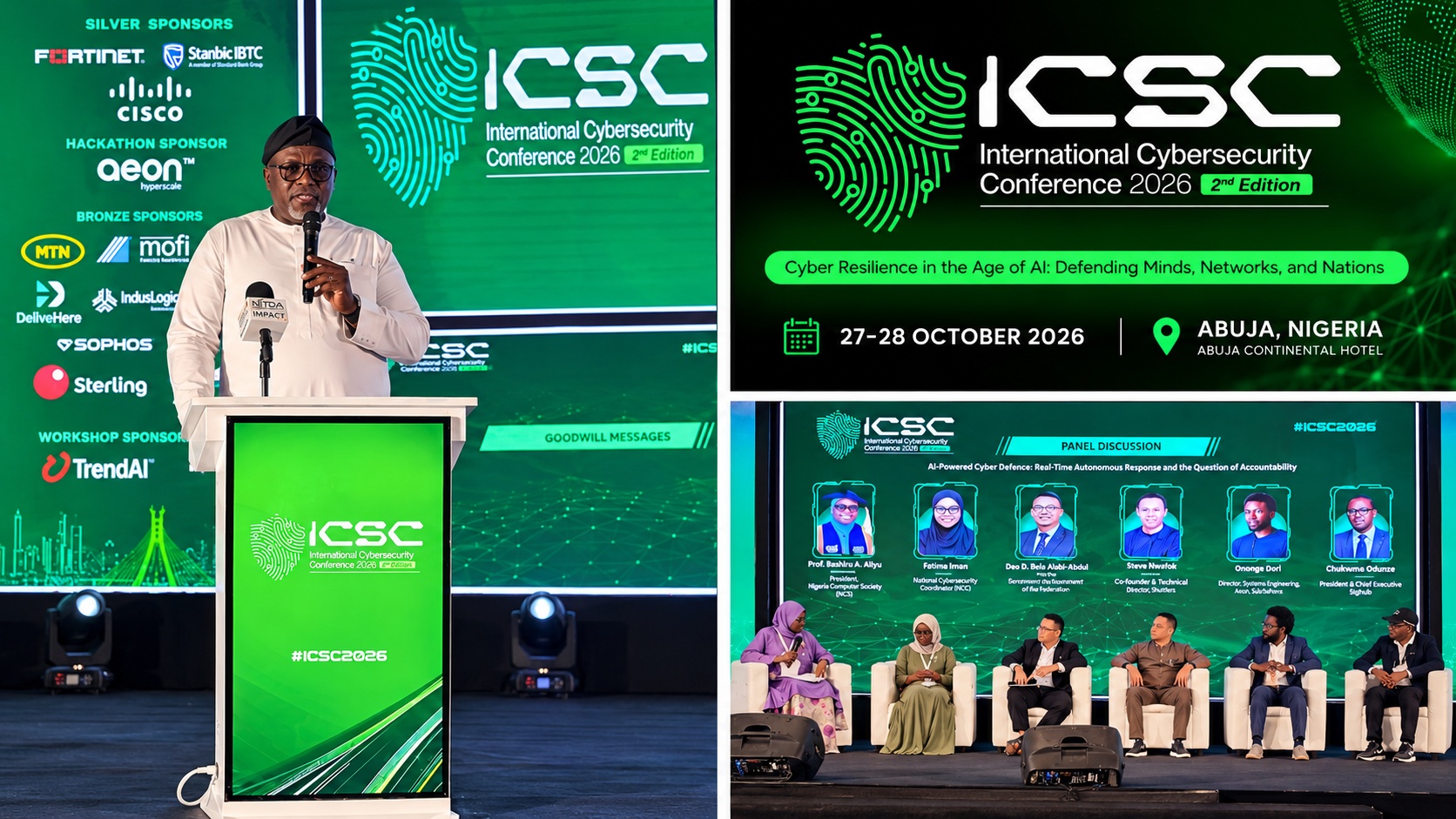
House Committee on ICT and Cybersecurity Chairman highlights the need for stronger international cooperation as artificial intelligence reshapes digital threats.
Hon. Adedeji Dhikrullahi Stanley Olajide, popularly known as Odidiomo, has called for cybersecurity laws that can keep pace with emerging technologies, alongside stronger international cooperation to protect Nigeria against increasingly sophisticated digital threats.
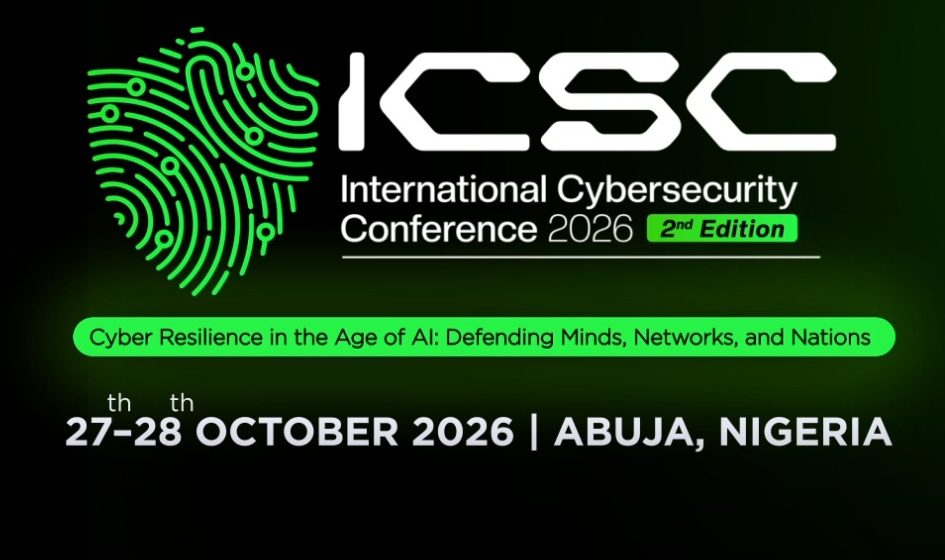
Olajide, Chairman of the House of Representatives Committee on ICT and Cybersecurity, made the call at the second edition of the International Cybersecurity Conference (ICSC 2026), held at the Abuja Continental Hotel from October 27 to 28, 2026.
Organised by the National Information Technology Development Agency (NITDA), the conference brought together policymakers, regulators, cybersecurity professionals, technology companies and international stakeholders to examine the challenges of protecting digital systems in an era increasingly shaped by artificial intelligence.
The conference theme, “Cyber Resilience in the Age of AI: Defending Minds, Networks and Nations,” reflected the growing need for coordinated action as artificial intelligence transforms the nature and scale of cyber threats.
Odidiomo Advocates Laws That Keep Pace with Technology
Odidiomo’s contribution centred on the importance of ensuring that Nigeria’s legal framework remains responsive to technological change.
As cyber threats become more sophisticated, he emphasised the need for adaptable legislation and stronger cooperation across institutions and national borders. Cyberattacks increasingly extend beyond individual computers and online accounts, potentially affecting critical infrastructure and essential services.
The risks to systems supporting food supply, commerce, public administration and other essential activities demonstrate why cybersecurity must be treated as a broader national development and security concern.
For Nigeria, strengthening digital resilience requires more than technical solutions. It also calls for effective laws, capable institutions and collaboration among the public sector, private industry and international partners.
The International Cybersecurity Conference featured participation from senior government officials, legislators, regulatory authorities and international representatives.
Among the dignitaries listed in the conference programme were Mallam Nuhu Ribadu, National Security Adviser; Dr. ‘Bosun Tijani, Minister of Communications, Innovation and Digital Economy; Lateef Fagbemi, Attorney-General of the Federation and Minister of Justice; and Kashifu Inuwa Abdullahi, Director-General of NITDA, who delivered the host agency’s welcome address.
The legislative delegation included Senator Shuaib Afolabi Salisu, Chairman of the Senate Committee on ICT and Cybersecurity, and Hon. Adedeji Stanley Olajide, Chairman of the House of Representatives Committee on ICT and Cybersecurity.
International participation included Adji Ali Salatou, Minister of Communication and New Technologies of the Republic of Niger; Senator Momo T. Cyrus of Liberia; Dr. Mohamed Hamad Al Kuwaiti, Chairman of the UAE Cyber Security Council; Pedro Verdelho, Chair of the Council of Europe Convention on Cybercrime Committee; and Sarah Osborn of the United Kingdom’s Foreign, Commonwealth and Development Office.
The programme also listed Aminu Maida, Executive Vice-Chairman of the Nigerian Communications Commission (NCC); Dr. Vincent Olatunji, National Commissioner and Chief Executive Officer of the Nigeria Data Protection Commission; and Olanipekun Ola Olukoyede, Executive Chairman of the Economic and Financial Crimes Commission, among the officials scheduled to contribute to the conference.
Their respective institutional responsibilities reflect the wide-ranging policy issues involved in cybersecurity, from telecommunications and data protection to criminal investigation, prosecution and national security.
Stakeholders Highlight Legal and Institutional Reforms
Discussions at the conference underscored the need to align legislation, law enforcement, regulatory oversight and technical capacity in responding to emerging digital threats.
In a message delivered on his behalf by Rotimi Oyedepo, Director of Public Prosecutions of the Federation, Attorney-General of the Federation Lateef Fagbemi disclosed that work had advanced on a draft executive bill intended to strengthen Nigeria’s cybercrime legal framework.
The proposed reforms were described as addressing emerging technologies, electronic evidence, investigation and prosecution, while maintaining safeguards for human rights and the rule of law.
NITDA Director-General Kashifu Inuwa Abdullahi also highlighted collaboration involving the agency, the Office of the National Security Adviser and the National Assembly in reviewing the Cybercrimes Act.
He drew attention to the growing misuse of artificial intelligence to generate deceptive voices, videos and images, illustrating how rapidly evolving technology can complicate the detection and investigation of digital offences.
Similarly, NCC Executive Vice-Chairman Aminu Maida, represented by Executive Commissioner for Technical Services Sunday Oshadami, highlighted the risks AI-powered attacks pose to telecommunications, financial services and government operations.
Together, these contributions reinforced a central message of the conference: Nigeria’s digital defences depend on legislation and institutions that can respond effectively to emerging threats while supporting responsible technological innovation.
Continuing Legislative Engagement on Cybersecurity
Odidiomo’s participation at ICSC 2026 builds on his engagement with cybersecurity policy at the maiden National Cybersecurity Conference in Abuja in 2025, where he called for an urgent overhaul of Nigeria’s digital protection laws and frameworks, describing cybersecurity as a matter of national survival.
His latest contribution reflects the importance of maintaining cybersecurity as a legislative priority as Nigeria’s digital economy expands.
Artificial intelligence is creating new opportunities across business, public services and communication. At the same time, it is introducing challenges involving fraud, impersonation, data protection and the security of critical systems.
Addressing these challenges requires a legal framework that can evolve alongside technology, supported by effective implementation and cooperation among national institutions and international partners.
For Odidiomo, the task is to ensure that Nigeria’s laws and institutions remain prepared for the threats accompanying digital transformation.
His intervention at the International Cybersecurity Conference in Abuja reinforces the need for forward-looking legislation and sustained cooperation to protect Nigeria’s digital infrastructure, strengthen public confidence and secure the country’s digital future.
Leave a Reply